
Timber surveys

Timber decay and woodworm surveys

Find out what is affecting accessible timbers and what action is justified.

Serving South and East Wales, Greater London and the Home Counties

A considered diagnosis

Understand the cause before deciding on repairs.

Evidence of wood boring insects or fungal decay needs context. We consider timber condition, moisture sources and ventilation, and distinguish observed activity from historic signs where the evidence allows.

See survey prices →

What we investigate

  • Accessible floor and roof timbers
  • Signs of wood boring insects and fungal decay
  • Sub floor airflow and contributing moisture
  • The extent and likely cause of visible damage

Your report

Clear findings and a useful next step.

A report explaining observed findings, limitations of access and practical next steps. Opening up concealed areas may be recommended where needed.

Tell us about your property ↗

Timber insect identification

Which beetle made these marks?

Five wood-boring beetles to recognise in British buildings. House longhorn has a limited range in Britain. Size, timber type and the dust around exit holes can offer clues, but a photograph or hole alone cannot confirm the species or whether an infestation is active.

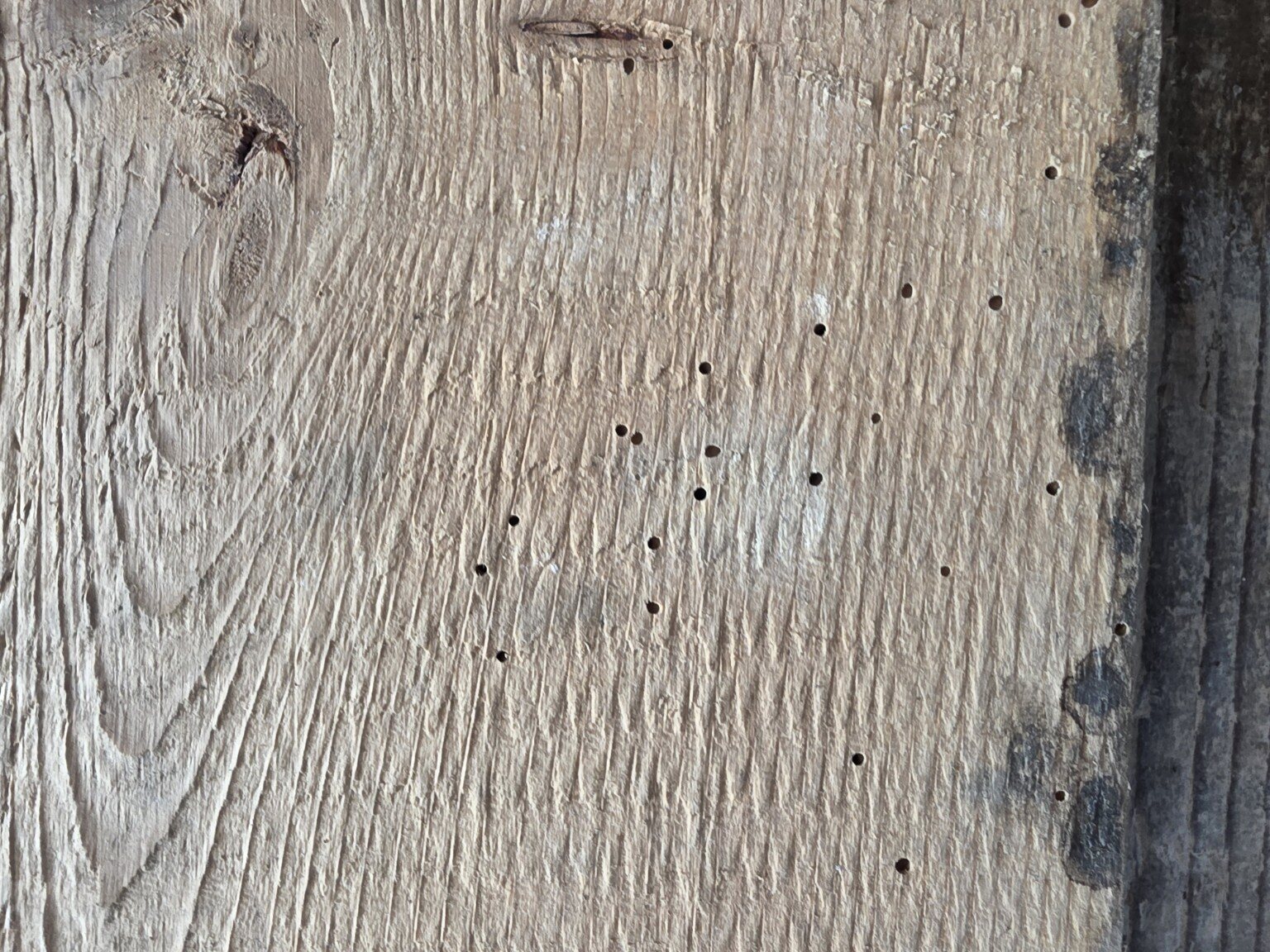
Small round exit holes in an exposed timber
Exit holes in timber — appearance alone does not establish current activity.
Adult common furniture beetle in side view
01 / Familiar woodworm2.5–5 mm adult

Common furniture beetle

Anobium punctatum

A small brown beetle with a hooded appearance: its head is largely hidden from above. It can affect structural softwood and furniture.

Clues in timber Round exit holes around 1.5–2 mm and fine, gritty bore dust.

See identification photos (opens in a new tab)
Adult deathwatch beetle with pale mottling
02 / Older hardwood5–9 mm adult

Deathwatch beetle

Xestobium rufovillosum

Larger and dark brown with pale mottling. It is associated with damp or decayed hardwood, especially in older buildings.

Clues in timber Round holes about 3 mm, coarse bun-shaped bore dust and sometimes a tapping sound.

See identification photos (opens in a new tab)
Adult powderpost beetle
03 / Hardwood sapwood4–5 mm adult

Powderpost beetle

Lyctus brunneus

A slim, flattened, reddish-brown beetle. Its larvae attack the sapwood of suitable wide-pored hardwoods.

Clues in timber Small round exit holes, often 1.5–2 mm, and very fine, flour-like powder.

See identification photos (opens in a new tab)
Adult house longhorn beetle with long antennae
04 / Localised in BritainAbout 16 mm adult

House longhorn beetle

Hylotrupes bajulus

A large, dark beetle with long antennae. Its larvae attack softwood sapwood. In Britain it is mainly associated with a limited area around north west Surrey and neighbouring districts.

Clues in timber Larger oval exit holes, often around 6–10 mm, with coarse bore dust.

View photograph (opens in a new tab)
Adult wood boring weevil with a narrow snout
05 / Damp, decayed timberAbout 3 mm adult

Wood boring weevil

Euophryum confine

A tiny reddish, elongated weevil with a distinct snout. Often found alongside common furniture beetle damage and in damp or partly decayed timber.

Clues in timber Small round holes and fine bore dust; check the surrounding timber for moisture and decay.

View photograph (opens in a new tab)
Found holes in a beam?

Old flight holes do not necessarily mean beetles are still active. A survey considers fresh evidence, moisture and the condition of accessible timber before recommending any action.

Ask about a timber survey
Image sources and licences